


A few days ago I saw Jamiroquai perform in Barcelona.
Their song Virtual Insanity won an MTV music award for best video in 1997, but they never really caught on in the mainstream. And that was on purpose.
Lead singer Jay Kay has said in interviews that he didn’t want to conform to what the record labels were asking of him. Now almost 30 years later, their music is more relevant than ever.
Virtual Insanity — that’s the theme of this weeks Sunday Serendipity…
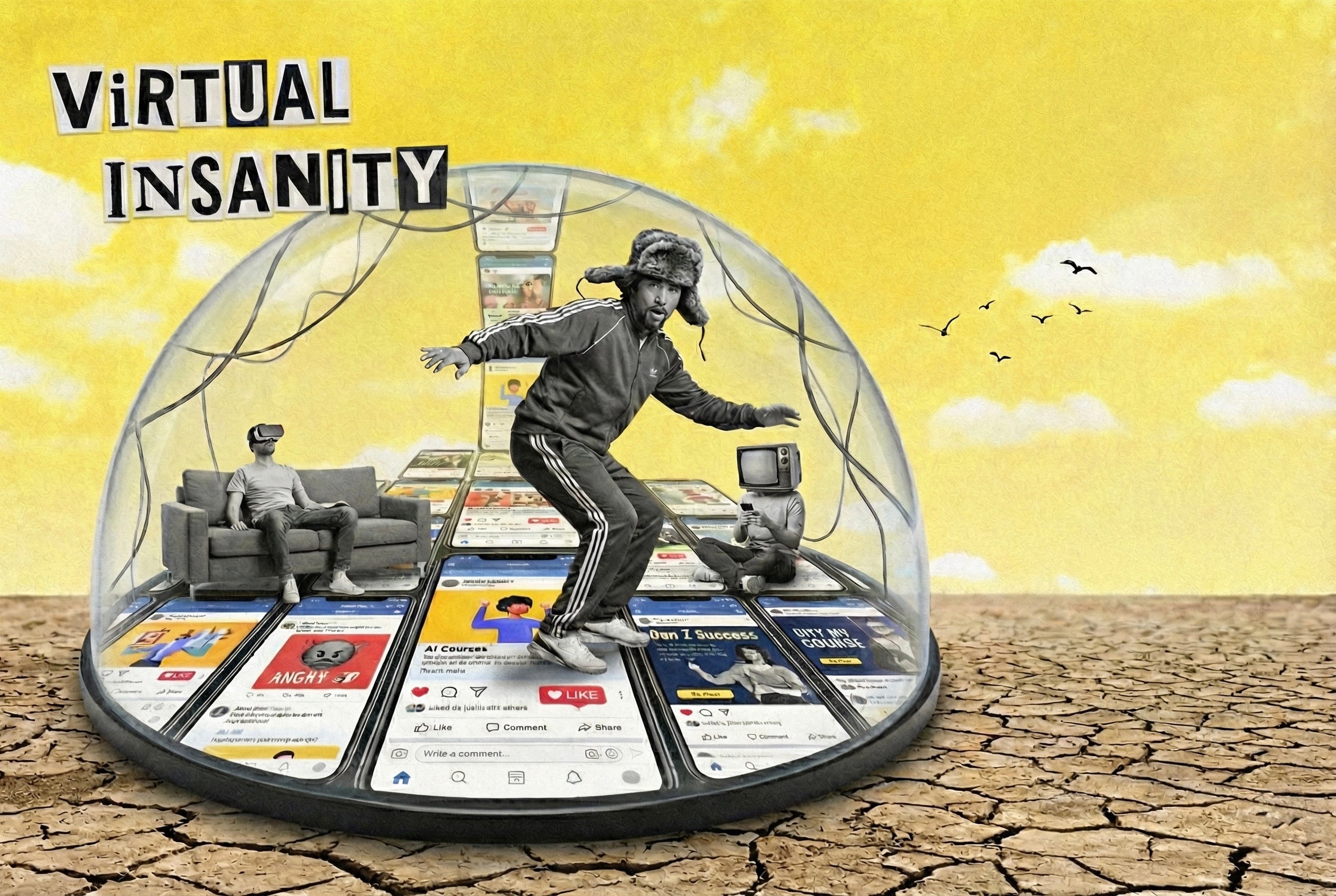
My first time seeing Jamiroquai was at Sziget Festival in 2008.
I was in Hungary for the summer visiting family and prior to this I’d never heard of them before. I remember my cousin and my friend Norbi were so excited.
Still to this day it’s one of the most memorable concerts of my life. Now after seeing them again, I realize how ahead of their time they were. This was written when cell phones were still a luxury and social media was non-existent:
“Futures made of virtual insanity”, what a tune, and he was right…
Now the average American spends more than 90% of their time indoors with 7 hours a day devoted to screen activity.1
We’ve become an indoor species and total time spent outdoors is the most insignificant part of the day. Jamiroquai’s music encapsulates what Niel Postman was writing about in Amusing Ourselves to Death a decade earlier in 1985.
There’s a running joke about how much Postman is cited recently, here’s Derek Thompson in a recent essay:
“Believe me, I tried to keep old Postman out of this—he’s over-exposed enough these days—but as I wrote, I could hear the ghostly thump-thump-thump of his posthumous fists knocking on the door of this essay, and I had to let him in.”
People are discussing Postman’s work because the things he warned about are coming true and have been amplified to extremes. Summed up by Matthew Yglesias here:
“The multi-generation moral panic about improved video entertainment driving social isolation is largely correct. The technology keeps improving, but it’s not making our lives better.”
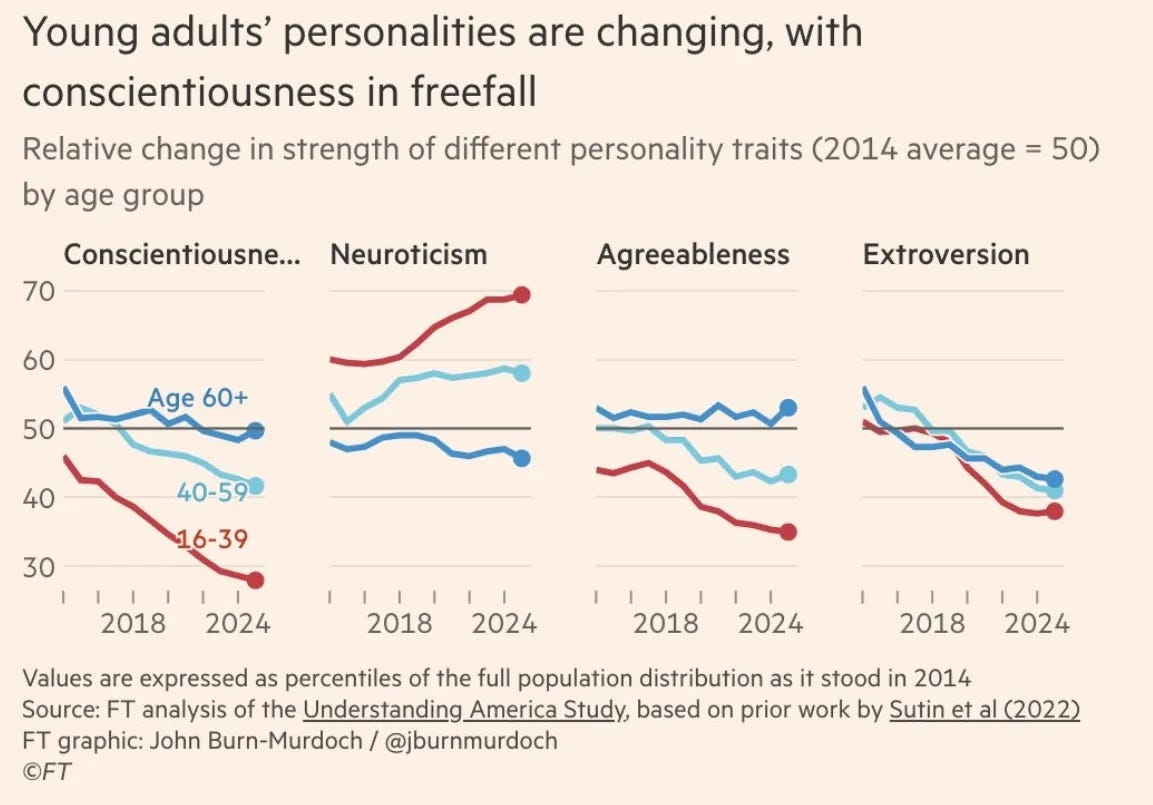
Conscientiousness and extroversion have dropped across all age groups becuase people are spending more time in the digital word, passively consuming and investing in para-social relationships instead of IRL relationships. Meanwhile neuroticism has increased leading to what Jon Haidt dubbed has the Anxious Generation.
I’m not against social media. Like all technology, it’s a tool. But as Noah Smith has observed, throwing the whole world into a single room together doesn’t work:
It started with the Facebook feed. On the old internet, you could show a different side of yourself in every forum or chat room; but on your Facebook feed, you had to be the same person to everyone you knew. When social unrest broke out in the mid-2010s this got even worse — you had to watch liberal friends and conservative friends go at it in the comments of your posts, or theirs. Friendships and even family bonds were destroyed in those comments.
At first Twitter seemed less bad than the Facebook feed, since you didn’t have to reveal your real identity if you didn’t want to. But Twitter was far more extreme in the way it threw everyone in the whole world together. Your family and friends might fight on Facebook, but at least you didn’t have to get deluged with angry comments from random anonymous Nazis or communists or weirdos mad about video game journalism.
The early 2010s on Twitter were defined by fights over toxicity and harassment versus early-internet ideals of free speech. But after 2016 those fights no longer mattered, because everyone on the platform simply adopted the same patterns of toxicity and harassment that the extremist trolls had pioneered. By 2019 you could get mobbed by angry librarians or history professors. The only defense against an angry mob was to get your own angry mob.
The never ending cycle of toxicity is causing the internet to become more fragmented.
More people are choosing to move away from bigger platforms like Meta and X to places like Substack and private communities.
Why some social media feels different
As described by one of the co-founders Hamish McKenzie — “Traditional social media is designed to lure us into an attention game that keeps us locked in an endless scroll. It can be fun, but it’s often maddening and divisive.”
Substack is social media, but it feels different. I like how Emma Gannon said it here:
I love Substack because it requires me to actually sit down and write every week—to find ways to express things, tell stories, ingest culture and books I love, and generate new ideas regularly. Writing and reading calm the nervous system. I’d always rather write something than make—or watch—a thirty-second video.
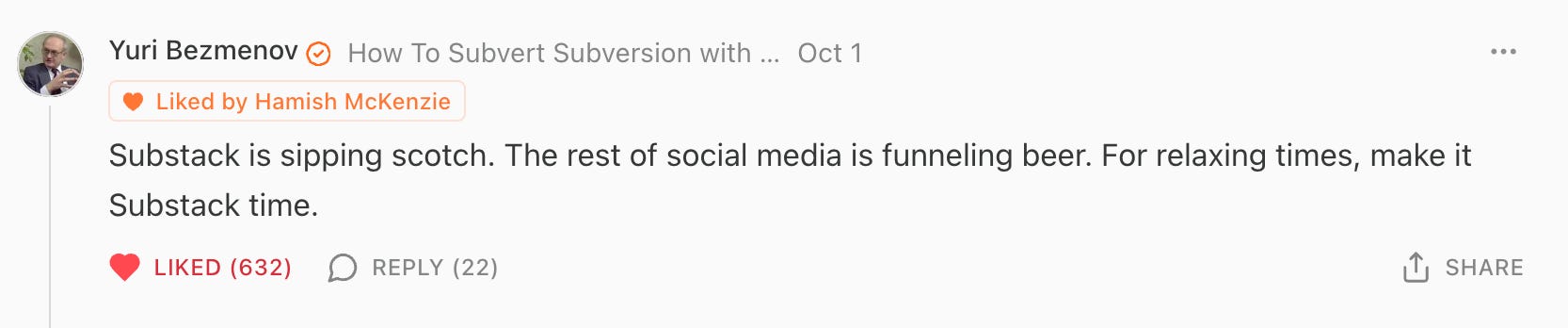
Since I started writing here, I’ve used Instagram less and less. I haven’t posted there all year, I mostly just use it as a messaging platform now.
Not that Instagram is all bad. I follow plenty of creators I look up to sharing cool stuff. What bothers me is the algorithm promotes the most extreme views and the ads have gotten to be overwhelming.
With AI, it’s only going to get worse. The ads and content you’re seeing will continue to be even more hyper-targeted causing people to spend more time on the app.
Here’s what Zuck said on the last earnings call:
Across Facebook, Instagram, and Threads, our AI recommendation systems are delivering higher quality and more relevant content. Video is a particular bright spot, with time spent on Instagram up more than 30% since last year. As video continues to grow, Reels now has an annual run rate of over $50 billion.
On YouTube I can pay for premium and choose whether or not I want ads. With Substack, I only subscribe to writers I want to read and there’s no ads being shoved in my face when I don’t want them. Substack also has a feature on Notes where I only see people I’m following.
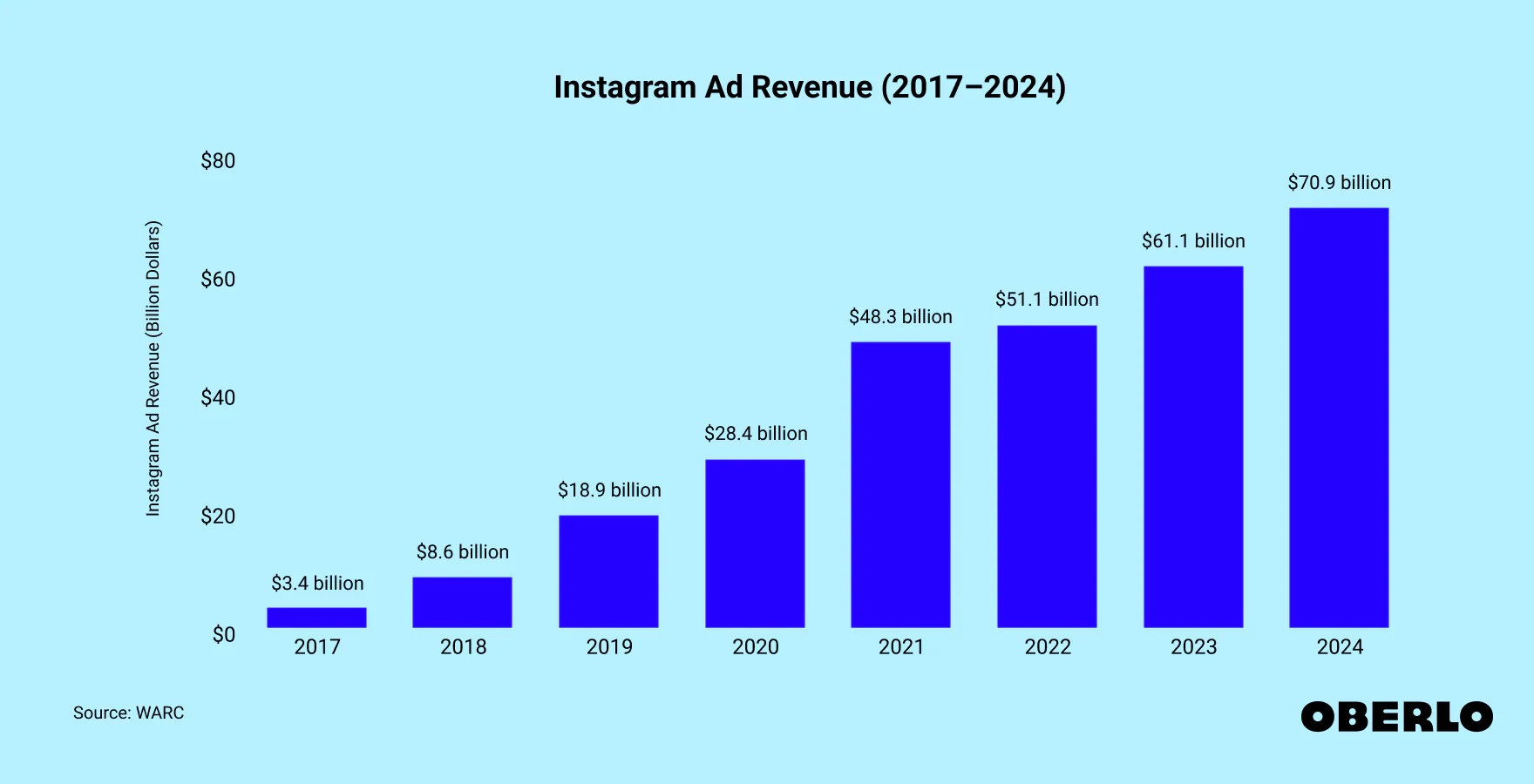
On Meta’s platforms, as far as I know there’s no way to turn off the onslaught of advertising and consumerism. Have you noticed the number of ads you get hit with has increased? In 2019, Instagram generated less than $20 billion in advertising revenue, now it’s grown to over $70 billion.
Every time I open the app, there’s a 20-something-year-old screaming at me to buy their course. What makes it worse is that they’re bringing religion into the marketing and preying on people’s emotional and psychological weaknesses.
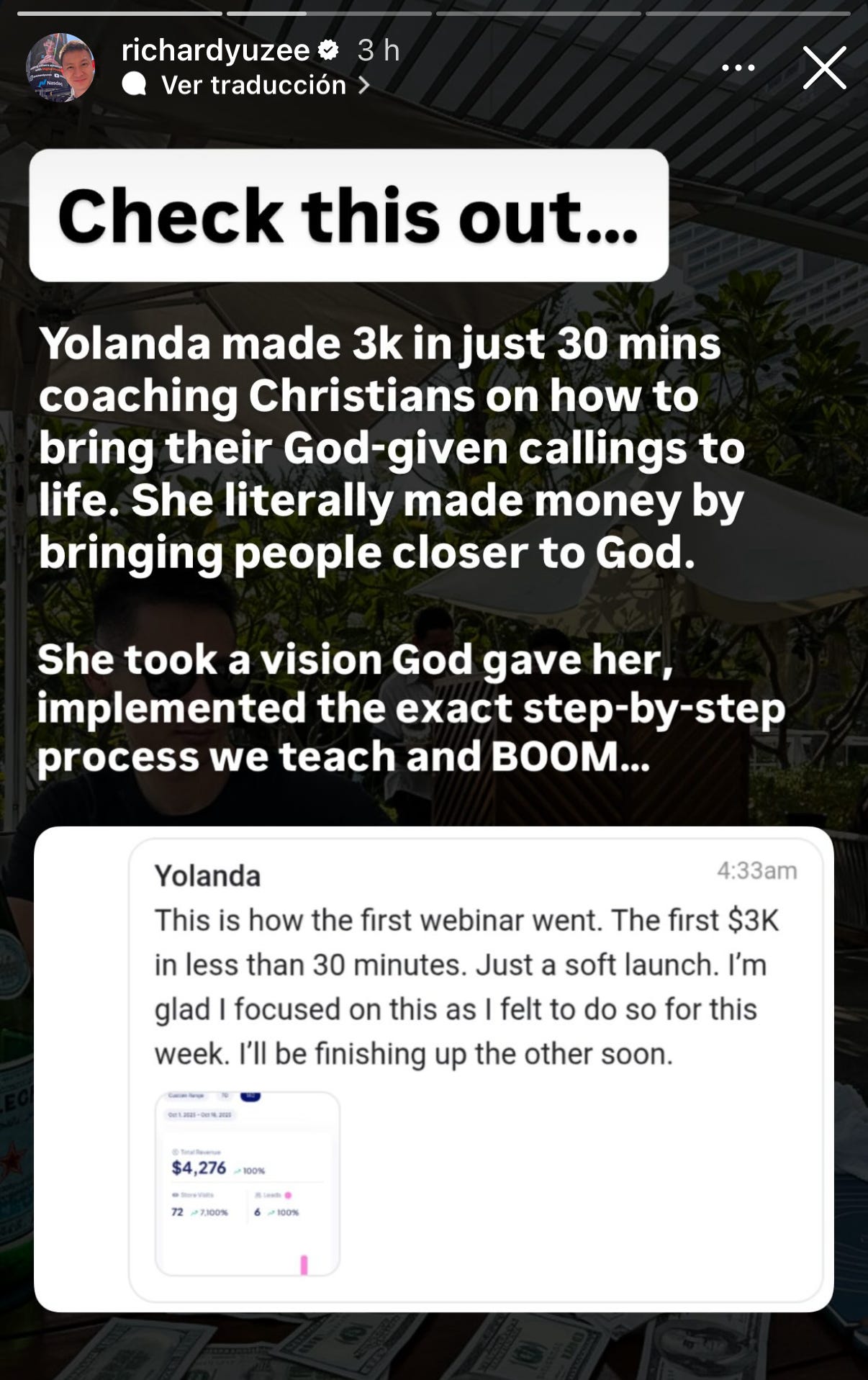
The other day I opened IG and the first video I saw was an AI marketer telling me that the reason Gen Z is thriving and happier than ever is because they started believing in God. He goes on to say that Gen Z is starting more businesses than any generation in history and that they’re in the best shape of their lives:
But the data tells a different story, Gen Z is the LEAST LIKELY to attend church:
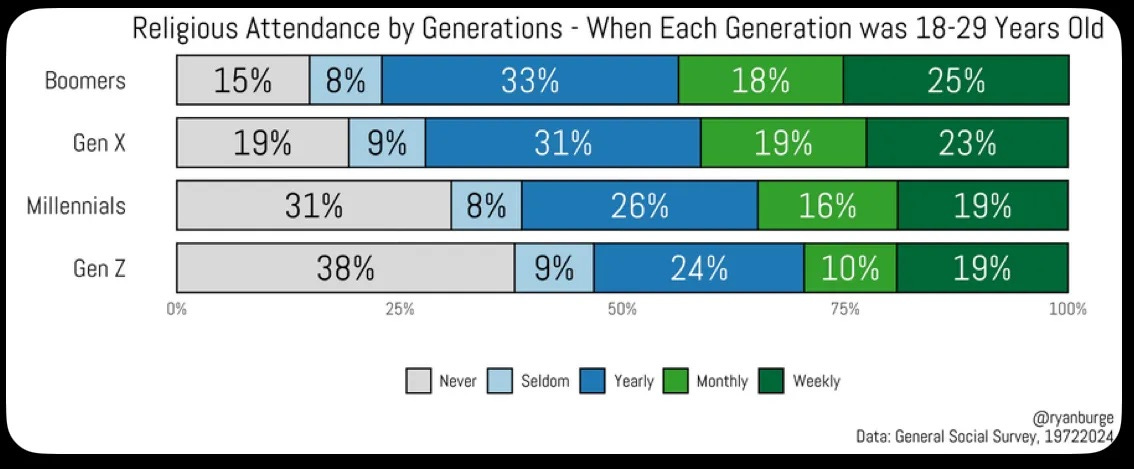
When the algorithm prioritizes conviction and engagement over facts it leads to more divisiveness. For these reasons, people are getting fed up with their attention being stolen by these giant monopolies.
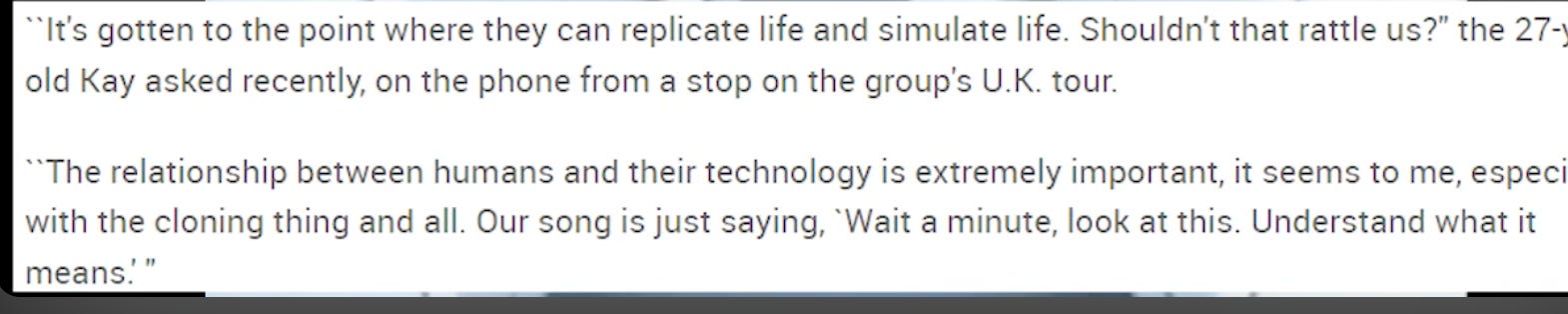
This all ties in to the message of Jamiroquai’s music, they’re not saying technology is bad, they’re just asking us to take a look at our relationship with technology:
Technology can bring us together or tear us apart. Depending how you use it and which platforms you engage on will determine your relationship with it.
See you next week,
<3 B
P.S. - Are you going virtually insane and spending too much time indoors? If so, I’m hosting a cycling and writing retreat in Spain next Spring. If this is something you’re interested in, fill out this form and I’ll be in touch with more info. 🚴🏼
https://www.epa.gov/indoor-air-quality-iaq/improving-your-indoor-environment
Who do you think our modern-day Postman is, with an accurate bead on where things will be at 30 - 50 years from now?
Jamiroquai is fun Brian! I hadn’t thought of them in ages, great band:) and let’s hope Substack stays ad free, fingers crossed as there have been some inklings otherwise.